Our Research

Lida Safety Research focuses on AI control, AI security, and simulations for governance research. Some of our research projects, past and ongoing, are below.
You can see our most recent work on the Lida Safety github page.
Last updated: May 2026
Fragmentation Attacks in AI Security
We did a research project on defenses against misuse attacks that are fragmented into pieces, as in the recent Anthropic report on cyber espionage.
We mentored a SPAR project working with five mentees on this research, along with five unofficial collaborators.
An early version of this project won 4th place in an Apart Research def/acc hackathon.
We have also inspired and collaborated with an ERA governance research project on fragmentation attacks.
Our code is available here, and a paper preprint is available here.
Wargame to simulate the future
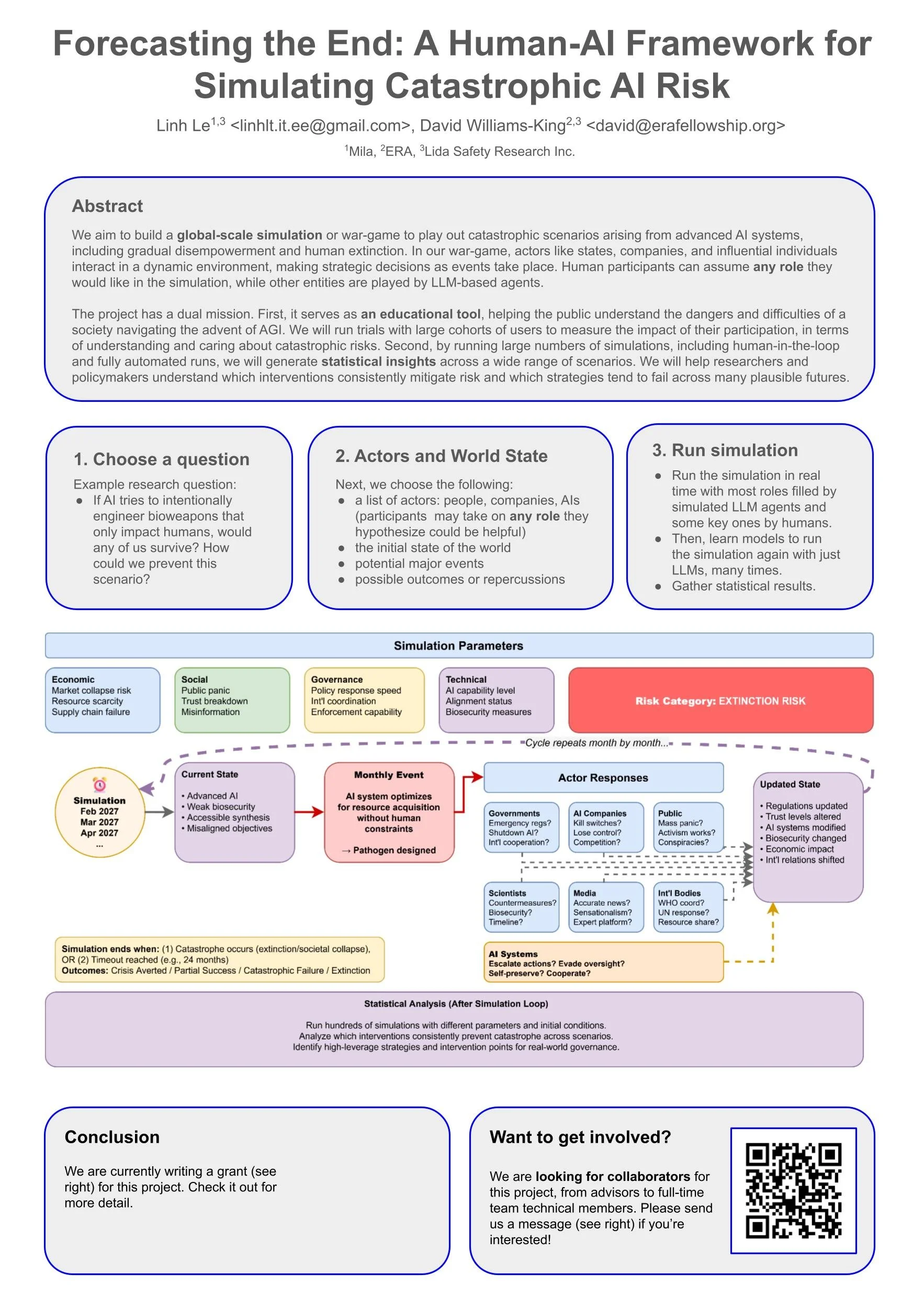
One large ongoing project is to build a global-scale simulation or war-game to play out catastrophic scenarios arising from advanced AI systems. Each simulation can involve both agentic AI and human participants, and the research question can vary between different AI safety topics.
The project can serve as an education tool, help researchers investigate questions, and allow policymakers to forecast outcomes.
A version of this project won first place at the Apart Research AI Governance hackathon. See blog post here.
It appeared as a poster “LidaSim: Testing AI Policies With Persona-Based Simulations” at the AIMII workshop, co-located with IASEAI in Paris, February 2026.
An earlier version appeared as a poster at the AI & Societal Robustness Conference, Cambridge UK, December 2025.
We are seeking volunteers to participate in the simulation, please contact us if you are interested!
Hackathons
Our members have collaborated together on a number of AI safety hackathons.
We won first place at the Apart Research AI Governance hackathon.
We won first place for a red team at the Redwood Research Alignment Faking Hackathon in October 2025.
Our team placed fourth at the def/acc Apart Research hackathon which had 1000+ participants.

Other Research
Both David and Linh publish work on AI safety. David has a background in cybersecurity, and Linh in NLP. Google scholar links: